The name trap: two spellings, several devices
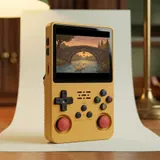
The box says 'R36Plus', while the label and the boot screen show 'R36S Plus'. Both names refer to the same device: the vertical console with a square 4-inch screen and built-in Wi-Fi, released in April 2025. Neither spelling is more authentic than the other, and 'original' here simply means the right version, not an official product. The catch is that a very similar name is used for other machines. An older 'R36S Plus' with a 3.5-inch screen and a single stick did exist.
Another source of confusion: some listings reuse the technical description of a different model. You might see, for example, a listing that states a 3.5-inch 640 x 480 screen next to a photo of a square screen. It is usually a copy-and-paste between similar models, not bad faith. The neighbouring models in the family muddy the waters too. The R36 Max has the same square screen but no Wi-Fi. The R36 Ultra has the screen and Wi-Fi, but illuminated sticks and a different board. The R36XX has Wi-Fi, but a 3.5-inch screen.
What to check on the listing
Before you buy, read the listing and look at the photos together. Do not rely on the title alone. Five features identify the right version, and all of them should appear, both in the text and in the pictures. If one is missing or contradicts another, ask the seller in writing before you order. Their reply will be useful if the device you receive does not match. Watch out for a screen listed as 3.5 inches or 640 x 480, and for a listing that says nothing about Wi-Fi or offers a USB dongle to add it.
In the photos, the format is easy to spot: the screen should look square, not rectangular. The announced dimensions are 82 x 142 x 28 mm. The console has no internal memory: everything runs from microSD cards, up to 128 GB per card. A listing that mentions built-in storage is therefore describing another device, or is simply wrong. The same goes for any mention of Bluetooth or 5 GHz Wi-Fi: this model has neither.
- A square 4-inch IPS screen, 720 x 720 pixels, in a 1:1 format.
- Built-in 2.4 GHz Wi-Fi, with no dongle or adapter to plug in.
- Two clickable analogue sticks (L3 and R3).
- Two microSD slots: TF1-OS for the system, TF2-GAME for games.
- A mainboard marked V20 (R36S Plus-V20).
| What to check | Where | What you should see |
|---|---|---|
| Screen | Listing, photos, then the console switched on | Square 4-inch screen, 720 x 720; a 4:3 game with bars at the top and bottom |
| Wi-Fi | Listing, then the system settings | Built-in 2.4 GHz Wi-Fi; a Wi-Fi menu depending on the installed system, with no dongle in the OTG port |
| Controls | Front of the console | Two clickable analogue sticks |
| microSD slots | Sides of the console | TF1-OS on the right, TF2-GAME on the left |
| Device name | Boot screen, label on the back, box | 'R36S Plus' at start-up and on the label, 'R36Plus' on the box |
| Battery | Under the door on the back | Printed capacity, 3,000 to 3,200 mAh depending on the batch |
| Mainboard (optional) | Seller's photo, or seen through the translucent shells | R36S Plus-V20 reference and Wi-Fi module on the board |
What to check when it arrives
When it arrives, keep the box and packaging until you have finished checking. Start with the screen: once switched on, it should be perfectly square. A 4:3 game shown without stretching keeps its proportions, with bars at the top and bottom. That is normal on this screen. Then open the settings. Depending on the installed system, a Wi-Fi menu appears there, with nothing plugged into the OTG port. To connect, you need a 2.4 GHz network. Finally, check the name: the boot screen shows 'R36S Plus'. Depending on the system, the information page in the menu also names the device.
Next, turn the console over. The label on the back reads 'R36S Plus'. Under the ridged battery door, the capacity is printed: 3,000 to 3,200 mAh depending on the batch. Check the sides as well: TF1-OS on the right, TF2-GAME on the left, Power and Reset on the left, volume on the right. On the bottom edge you will find three sockets: the USB-C port marked 'DC' for charging, the headphone socket in the centre and the USB-C port marked 'OTG' for accessories.
Board photos, for those who open their devices
The surest marker is still the mainboard itself. It is marked 'R36S Plus-V20' and carries the Wi-Fi module. That is the photo to ask the seller for if you still have doubts before buying. Opening the shell yourself is not recommended. You have to take the device apart and handle fragile connectors, and dismantling it can complicate an exchange. The earlier checks are almost always enough. A square screen, a Wi-Fi menu without a dongle and the right name at start-up already point to the right version.
There is a gentler way to glimpse the board. The purple and 'lake blue' shells are translucent, so the board shows through. A photo taken through the shell does not replace a photo of the bare board, but it can help clear up a doubt. If you ask the seller for a photo, say exactly what you want to see: the R36S Plus-V20 reference and the Wi-Fi module on the board.
If it is not the right version
Is your screen rectangular, the Wi-Fi menu missing or the name wrong? Do not open anything and do not modify the cards. Photograph the screen switched on, the label and the settings with no Wi-Fi option. Keep a screenshot of the listing too. Then write to the seller, calmly, describing the difference between the listing and the device you received. If you bought on a marketplace, use its messaging system. It is often a batch mix-up or copied text, and an exchange sorts it out.
If the exchange falls through, your consumer rights protect you. In the UK, when you buy online from a business, you generally have 14 days to cancel, and consumer law requires goods to match their description. If you bought from a business based in the European Union, the two-year legal guarantee of conformity in principle covers a product that does not match its description. On our side, orders only open once the supplier has confirmed the 4-inch version with built-in Wi-Fi in writing. The R36S Plus sold here is that version, with a square 4-inch screen and built-in Wi-Fi.
Frequently asked questions
Can I use the Wi-Fi to play online?
No. Depending on the installed system, the 2.4 GHz Wi-Fi fetches cover art and images for the games you already own. It also lets you enable RetroAchievements, install free ports through PortMaster and run the updates offered by the system. Finally, it lets you transfer files from a computer on the same network. It does not allow online play, network multiplayer or streaming. There is no Bluetooth.
Is the R36S Plus more powerful than an R36S?
No. It uses the same Rockchip RK3326 chip and 1 GB of RAM, so emulation performance is the same. What changes is the square 4-inch 720 x 720 screen, with around 36% more image area, and the built-in Wi-Fi. A listing that promises more power than the R36S is describing the device incorrectly.
Does the shell colour help identify the version?
Not really. The R36S Plus comes in white, black, purple, 'lake blue' and yellow, the last with red sticks. The shade can vary from batch to batch, and other models come in similar colours. A football pattern suggests the R36 Max, and illuminated sticks the R36 Ultra. Rely first on the screen, the Wi-Fi and the name.
Do I need to install another system to check the version?
No. The preinstalled open-source Linux system is enough to check the screen, the Wi-Fi menu and the name at start-up. Community systems exist for this model, but installing one is at your own risk, after backing up the cards. Do your checks before installing anything: a device left in its original state is easier to present to the seller if something does not match.
Sources
- Handhelds Wiki, R36Plus
- Retro Handhelds, R36Plus review (May 2025)
- Gouforit, R36Plus consola retro (August 2025)
- Handhelds Wiki, R36S Plus (Allwinner F1C200S, a different device)
- Notebookcheck, R36S Plus: 1:1 retro gaming handheld
Our guides are based on the supplier's product sheets and public documentation. We do not claim any hands-on testing.