What capacity changes, and what it doesn't
The capacity of a microSD card is storage space, nothing more. A 128GB card does not make the R36S Plus any faster than a 64GB card. Both configurations use the same Rockchip RK3326 chip and the same 1GB of RAM. Games don't run better and menus don't open more quickly. What changes is how many files you can keep on the games card without having to pick and choose. That mostly depends on the type of games you own.
Games from 8-bit and 16-bit consoles, and from handhelds of the same era, are small files. CD-based games from 32-bit consoles are much larger, because each disc becomes a full image. Depending on the installed system, cover art fetched by the scraper, save files and ports installed through PortMaster also take up space. If your collection is mostly cartridge games, capacity matters very little.
Why a card shows less than its stated capacity
A card sold as 64GB will never give you 64GB of usable space. This is normal and applies to every brand. Manufacturers count in powers of 10: to them, a gigabyte is one billion bytes. Computers and consoles count in powers of 2, which shows a smaller figure for the same number of bytes. Formatting then sets aside a small part of the space for the file system structure. In the end, the free space is lower than the figure printed on the card.
Leave some headroom on the games card as well. A card filled to the brim leaves little room for new saves and downloaded images. On the system card, part of the space is already taken by the preinstalled open-source Linux system. To work out what you need, add up the actual size of your files on your computer. Then compare that with the free space shown once the card is formatted, not with the figure on the packaging.
| Capacity | Suits | Good to know |
|---|---|---|
| 64GB | 8-bit and 16-bit games, classic arcade, older handhelds | Usable space is below 64GB after formatting |
| 128GB | Collections with lots of CD-based games, everything in one place | Configuration still being confirmed |
| Spare system card | All owners | Write the image of the original TF1-OS card to it |
| Spare games card | Anyone who rotates between several selections | Well-known brand, UHS-I, U1 or U3, A1, up to 128GB |
Two card slots, two jobs: TF1-OS and TF2-GAME
The R36S Plus relies on two microSD slots. The TF1-OS slot, on the right-hand side, holds the system card. This is the card that boots the console and contains the menu, the emulators and your settings. Without it, the console won't start. The TF2-GAME slot, on the left-hand side, takes the games card. This split is handy. You can move to a larger games card without touching the system, or replace the system card without losing your games.
The system card deserves the most care. If it is damaged or badly copied, the console will no longer start, even with a perfectly good games card. A reliable branded card therefore matters more in TF1-OS than in TF2-GAME. Depending on the installed system, the games card also needs to be formatted in a supported format and keep the expected folder structure. The system's documentation explains this.
Which microSD card to buy
For the R36S Plus, there is no need to go for the most expensive cards. Reliability is what counts. A card from a well-known brand, UHS-I and marked U1 or U3, will do the job. The A1 logo is enough: A2 is not needed for this use. The documented capacity goes up to 128GB, so stay within that limit. Buy from a reputable retailer, as fake versions of branded cards do exist. When the card arrives, format it and check the space shown before copying your files across.
Avoid unbranded cards or cards sold at a suspiciously low price. Some claim a capacity they don't actually have and start losing files once a certain point is reached. On the system card, that is the surest way to end up with a console that won't start. If you buy a spare card, choose the same type as the one you already use.
- Well-known brand, bought from a reputable retailer
- UHS-I standard
- U1 or U3 class
- A1 logo, enough for this use
- Up to 128GB, as documented for this model
Back up both cards before you change anything
Before replacing a card, reformatting it or trying another system, make a copy of both. Switch the console off, remove the cards and read them on a computer with a card reader. For the TF1-OS card, create a full image with disk imaging software: simply copying the visible files is not always enough to make a system card bootable. For the TF2-GAME card, copy all of its contents into a folder, save files included.
Community firmware exists for this model. It is neither supplied nor supported with the console, and installing it is at your own risk. With an image of the original system card, you can always go back. Keep two copies, one on your computer and one on another drive. Label each card too, TF1 and TF2, so you don't swap them when you put them back.
64GB or 128GB: which capacity suits you
Choose 64GB if you mainly play 8-bit and 16-bit console games, classic arcade games or older handheld games, and you don't mind being selective. It is also a sensible choice if you keep your full collection on your computer and swap games now and then. Choose 128GB if you have lots of CD-based games, want everything in one place, or fetch plenty of images with the scraper, depending on the installed system.
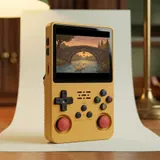
A spare card is useful either way. A ready-to-use copy of the system card means you won't be stuck if the original fails. The R36S Plus sold here is the version with a square 4-inch screen and built-in Wi-Fi. The 64GB configuration is planned. Availability of the 128GB configuration is still being confirmed, and exactly which cards are included is confirmed before you order.
Frequently asked questions
Can I use a card larger than 128GB?
The documented capacity for the R36S Plus goes up to 128GB. Beyond that, there is no guarantee the installed system will recognise the card or format it properly. If you run out of space, it is safer to use two games cards of no more than 128GB each and swap between them, switching the console off before each change.
Can I add games without taking the card out?
Depending on the installed system, yes: the built-in Wi-Fi lets you transfer files from a computer on the same network. You need a 2.4 GHz network, as the console does not support 5 GHz. You set up the connection in the console's menu. To copy a lot of files in one go, your computer's card reader remains a simple option.
What should I do if the console won't start after changing a card?
Switch it off, then check that the system card is in the TF1-OS slot on the right-hand side and the games card is in TF2-GAME on the left. If the problem continues, write the system card image you backed up to a branded card, then try again. Without that image, getting the console running again is much more complicated.
Can I reuse the microSD card from an old phone?
Yes, if it is a branded card in good condition, UHS-I and no larger than 128GB. Copy its contents first, as preparing it for the console wipes everything. If the card is old or has already shown errors, keep it for games rather than the system, or replace it.
Sources
- Handhelds Wiki, R36Plus
- Retro Handhelds, R36Plus review (May 2025)
- Gouforit, R36Plus consola retro (August 2025)
Our guides are based on the supplier's product sheets and public documentation. We do not claim any hands-on testing.